



 English
 Chinese
 Japan
Japan German
News

Tensile Bending Explained: How Precision Shapes Complex Metal Profiles
Metal profiles are widely used in architecture, transportation, industrial equipment, machinery, and many other applications. While straight profiles are suitable for conventional structures, modern designs increasingly require smooth curves, large-radius arcs, and customized shapes. This is where tensile bending becomes an important metal forming process.
Tensile bending combines controlled tension with bending force to form metal profiles into predetermined curves. Compared with simply applying force to a profile, the process requires careful control of material behavior, bending radius, springback, and cross-sectional deformation. When properly applied, tensile bending can produce consistent curved profiles while maintaining the functional and visual characteristics of the original material.
What Is Tensile Bending?
Tensile bending is a forming technique in which a metal profile is subjected to controlled tensile stress while being bent around a defined radius or forming die. The combination of stretching and bending helps guide the material into the desired shape.
During conventional bending, a profile may experience compression on one side and tension on the other. Depending on its cross-sectional geometry and material properties, this can lead to distortion, wrinkling, twisting, or springback. Tensile bending introduces additional tension during the forming process, helping control how the material deforms.
The exact process parameters depend on the material, profile geometry, wall thickness, bending radius, and required dimensional accuracy. Aluminum profiles, stainless steel sections, steel tubes, and other metal components may require different approaches.
Why Precision Matters in Tensile Bending
The primary challenge in tensile bending is not simply creating a curve. It is producing the required curve while keeping the profile dimensionally stable.
A metal profile can change shape in several ways during bending. The overall radius may deviate from the drawing, the cross-section may become flattened, or the profile may twist along its length. Springback can also cause the final shape to differ from the forming position.
For projects involving multiple curved components, consistency is particularly important. Even relatively small differences between individual profiles can create installation difficulties when the parts need to be assembled together.
For this reason, precision control should begin before production. Engineers need to review the profile cross-section, material characteristics, target radius, total length, and tolerance requirements before selecting an appropriate forming method.
The Role of Material Properties
Material selection has a direct influence on tensile bending performance. Different metals have different yield strengths, elongation characteristics, hardness levels, and springback behavior.
Aluminum profiles, for example, are lightweight and versatile but can be sensitive to localized deformation depending on the alloy, temper, and profile design. Stainless steel offers excellent corrosion resistance but may require higher forming forces.
The same profile geometry may therefore behave differently when manufactured from different materials. Understanding these characteristics allows manufacturers to determine suitable tension levels, bending sequences, tooling arrangements, and process parameters.
Managing Springback
Springback is one of the most common concerns in metal bending. After the forming force is released, the material tends to partially return toward its original shape because of its elastic properties.
If springback is not taken into account, a profile designed to have a specific radius may end up with a slightly larger or otherwise different radius after processing.
Manufacturers can compensate for springback by adjusting the forming parameters and using appropriate tooling strategies. In some applications, test bending is useful for determining the actual material response before full production begins.
This is especially valuable for custom profiles and low-volume projects where there may be limited previous production data.
Controlling Cross-Sectional Deformation
Maintaining the original cross-sectional shape is another important aspect of tensile bending.
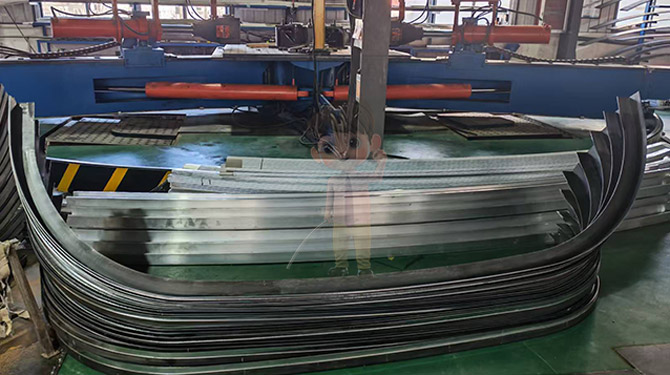
A hollow or thin-walled profile can be more susceptible to deformation than a solid or relatively simple section. During bending, certain areas of the profile may experience greater compression or tension than others. Without appropriate process control, this can result in local flattening, distortion, or twisting.
Tooling and support methods should therefore be selected according to the geometry of the profile. The forming process should distribute forces as evenly as possible while maintaining the intended shape.
For applications where appearance is critical, surface protection is also important. Scratches, pressure marks, and other surface defects may become highly visible after the profile has been installed.
Applications of Tensile Bending
Tensile bending is used across a wide range of industries.
In architectural applications, curved aluminum and metal profiles can be used for curtain walls, window and door systems, decorative structures, canopies, ceilings, and interior features. Curved profiles can create flowing architectural forms that would be difficult to achieve with straight sections.
In transportation, bent metal profiles may be used in rail vehicles, automotive components, marine structures, and specialized transportation equipment. Dimensional consistency is particularly important when multiple components must fit together.
In industrial manufacturing, tensile bending can be applied to machine frames, protective structures, equipment housings, support components, and customized metal assemblies.
The process is also useful when designers require long, continuous curves rather than assemblies made from multiple short straight pieces. A properly formed continuous profile can reduce the number of joints and provide a cleaner overall appearance.
Tensile Bending vs. Conventional Bending
Although both processes are used to create curved metal components, tensile bending and conventional bending are not necessarily interchangeable.
Conventional bending may be suitable for relatively simple shapes, standard sheet metal parts, and applications where minor deformation is acceptable. Tensile bending, on the other hand, is particularly useful when the profile must maintain its shape while achieving a controlled and continuous curve.
The choice between different forming methods should depend on the actual product requirements rather than the name of the process alone. Material, profile geometry, production volume, radius, tolerance, surface requirements, and cost should all be considered.
How to Prepare for a Tensile Bending Project
Customers can make the manufacturing process more efficient by providing complete technical information at the beginning of a project.
Useful information typically includes the profile drawing, material specification, cross-sectional dimensions, profile length, required bending radius, bending direction, quantity, and dimensional tolerances. If the component has specific surface requirements, these should also be communicated in advance.
For complex shapes, a three-dimensional drawing or physical sample can provide additional information. The manufacturer can then evaluate the feasibility of the requested geometry and determine whether testing or process development is necessary.
Tensile bending is more than simply forcing a metal profile into a curved shape. It is a controlled forming process that requires a good understanding of material behavior, profile geometry, tension, bending force, springback, and dimensional control.
When these factors are properly managed, tensile bending can produce smooth and accurate curves while helping maintain the structural and visual characteristics of metal profiles. This makes the process valuable for architectural structures, transportation equipment, industrial machinery, and customized manufacturing projects.
For any tensile bending application, the most appropriate process should be determined according to the specific material, profile design, radius, tolerance, and production requirements. Careful engineering analysis and process control from the beginning can help reduce deformation, improve consistency, and achieve a finished profile that closely matches the intended design.
 LIST
LIST16
2026-09
Number of visitors:1
HOT NEWS
-
Custom Metal Bending Solutions for Industrial Manufacturing
2026-10-14
-
Aluminum Bending Services | Professional Aluminum Profile Bending Solutions
2026-09-30
-
Tensile Bending Explained: How Precision Shapes Complex Metal Profiles
2026-09-16
-
Custom Aluminum Profile Stretch Bending Solutions
2026-09-01